WILDLY UNNECESSARY SPECIALIST PLASTIC BAGS

“But I’ve got my Bag for Life!” I hear you cry!

Yes, yes, of course you have. Me too. In fact, I’ve got seventeen Bags For Life, because I keep forgetting to bring them to the supermarket so I have to buy a new one, simply proving that I’m a forgetful twazzock of epic proportions.

In fairness, plastic bags are only the teensiest, tiniest part of the problem of plastic pollution, but we have to start somewhere.

And they’re everywhere. Here’s a by-no-means comprehensive list of single use bags you can stop buying. You have to hand it to the packaging manufacturers and their marketing departments, they’ve worked REALLY hard to make us think we need different bags for every occasion!

Sandwich bags. Lordy Bill, there are so many other ways to keep your sarnies fresh – in a wax wrapper. in foil or greaseproof paper – or even a plastic box you can use again and again.

Snack bags. Yes, there are such things and they are entirely separate and distinct from sandwich bags. Big Bad Bag Corp would like us to believe that we need BOTH snack bags AND sandwich bags. OMG, imagine the confusion if you put your snack in your sandwich bag and your sarnie in your snack bag! You might eat your BLT double decker thinking it was a piece of fruit and then you’d have nothing left for lunch! Gastronomic confusion would reign supreme!

Pictures of fruit on the bags are there to make you think you’re taking the healthy option.

Freezer bags. These are not particularly practical. They flop in the freezer and either stick to the surface or wrap themselves round whatever they’re sitting on. Boxes stack so much better and can be reused indefinitely with care.

Stoopid.

Ice cube bags. Yes. Ice cube bags. I ask you. ICE CUBE BAGS!!! Which you have to tear and shred to get the ice out and then throw away… Oh puh-leeeeeeeeze! Use an ice tray!!!

Slow cooker liners. Whaaat? People actually COOK their FOOD in a PLASTIC BAG, without wondering what petrochemical-type contaminants might be leaching into their food? Yikes. The packet says “Keep pots clean – seal in flavour”. Accept it, making stews means you have to wash the pot afterwards. Just soak it overnight, or leave it on simmer full of water for a while, and that should make the crusty bits come off the side.

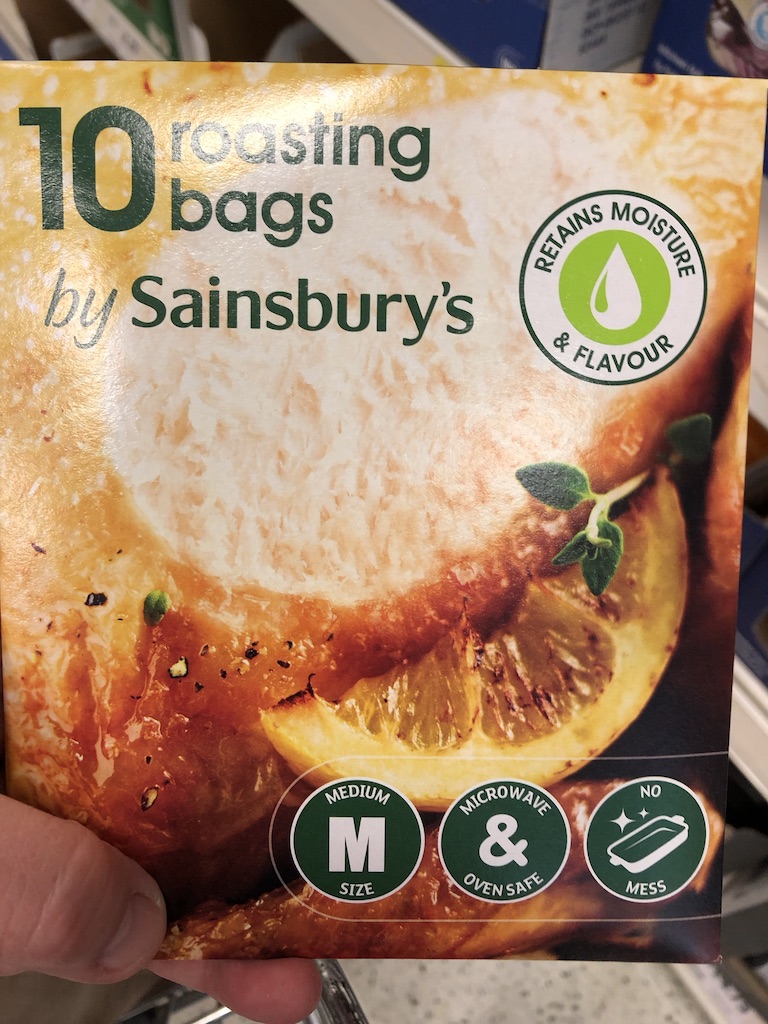
Roasting bags. Again, another ruse to sell you something completely unnecessary in the belief that somehow it will save you time and effort. It means you miss all the gorgeous, gooey cooking juices under the meat. If you want to protect the top of the dish from burning, use a saved butter wrapper and mould that round your chicken or yer chops or whatever. And if you really want to seal in your roast and keep your oven clean, you can make a ‘bag’ from a large piece of greaseproof paper. Eezi-peezi.
Wastepaper bin liners. Are you a hotel? Probably not. And even if you are, stop it. Put a piece of newspaper at the bottom of the bin if you must. I hate the way hotels put those flimsy liners in their bins. Thousands and thousands of these get dumped every day with just a tissue or a couple of bits of cotton wool in them. If hotels equipped their chamber staff with rubber gloves and a damp cloth it would be a great deal better for the environment. (I now travel with a plastic box for my waste cottonwool etc., and instead of using the bins in hotel rooms, I take it home and dispose of it there.)

Dog poo bags made of plastic. No excuse, chaps, been here before. You can get biodegradable bags everywhere in which to pop those plops.

Customs bags. You know, the ones they make you put your costmetics in to go through the machines at the airport. Get one, and keep it for next time. And the next. And so on.

What about big bin bags?

As to big bin bags, I’m resigned to having to use them. The hazards of being a garbage collector are enormous – they never know what foul stuff they’re picking up, whether it’s diseased, or full of rodents, insects, toxic waste, hypodermic syringes, broken glass etc etc… So until such time as garbage collection is mechanised, bin bags are vital for providing at least a small level of protection for these workers.

But most plastic bags are unnecessary, and if you need to be reminded of how plastic never disappears from the planet even when you can’t see it, read my piece on cling film/Saran wrap. If that doesn’t give you the holy horrors, I don’t know what will.

Nice and short this time, eh!

All photographs taken by Yours Truly, most of them in Sainsbury’s of Bicester. I think we can all agree that I’ve done a MARVELLOUS job. Okay, they’re a bit shite, but frankly I haven’t yet got used to the embarrassment of going round shops and photographing things like a weirdo.

My current challenge

I’m on tour, which means eating microwave meals at the theatre every day. I’ve challenged myself to do this without single-use plastic and am reporting my progress on my Twitter feed. It’s quite bothersome but because I am such a geek, I’m rather enjoying the challenge. @DillieKeane if you’re interested. Also @ShitYeDontNeed.

And finally… Here’s a picture of a hound, but not Piper this time as she is fed up with me for going on tour and refused to pose. Sorry, Pips, I shall be home the whole summer and we’ll make hay (and definitely jam) together and you can play hide and seek in the dahlia forest.

Meanwhile, this is Barney, our beloved Labrador, in the Drug Chair. It’s called the Drug Chair because there are strange aromatic medicaments in the upholstery that cause whoever sits there to go to sleep during interesting television programmes which means the rest of us have to watch them again.

Barney, an 11 and a half year old puppy, here asking you to admire his mighty tackle. He’s such a bloke, really. Even still, he is the nicest, gentlest, huggiest chap in the world.

ALMONDS…

Or mainly, almond milk. Yes, that surprisingly pleasant milk-substitute beloved of Clean Eaters everywhere.

As more of us drift towards a meat-free life, it beckons temptingly. You’re almost elevated to dietary sainthood the moment you whisper with a shudder, “Oh! I don’t do dairy, do you have any almond milk?”

Yes, it’s hugely popular, not just with vegan converts and bearded hipsters, but those unlucky enough to be lactose or dairy intolerant. When I was young, no-one had ever heard of lactose intolerance. I suppose people just suffered in silence and wondered why a milky coffee made them fart like an ancient Morris Traveller.

However, there is nothing virtuous about almond milk. Nothing at all.

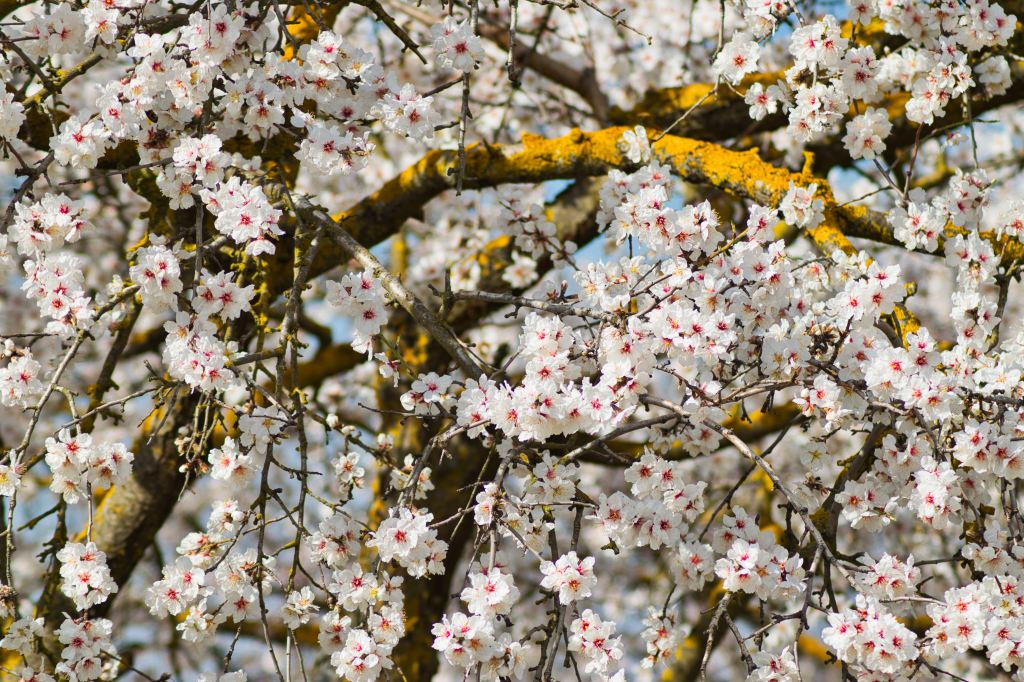
I have no idea if this is almond blossom, but it is very pretty and livens up the page a bit.
Photo by Jorge Alvarez on Unsplash

Are Californians drinking dirty water?

On average, it takes 12 litres of water to grow one almond. 12 litres! Almost as bad as avocados

Most of the world’s almonds come from California, so there’s quite a carbon footprint too. According to the Almond Board of California, and they should know, the state “produces about 80% of the world’s almonds and 100% of the U.S. commercial supply. Almonds are California’s #1 agricultural export.”

It’s also the most extensively irrigated crop in the state, in spite of the fact that poor old California has had an appalling drought since 2010.

All trees that produce crops of any kind need a constant supply of water, so when there’s no rain, farmers irrigate their crops with water taken from wells drilled deep down into the aquifers. These are layers of permeable rock containing groundwater.

In normal times, aquifers are refilled with rain. But after 10 years of drought, the higher aquifers are empty. So farmers are drilling deeper and deeper. This means the quality suffers. Why?

  • Salinity increases the deeper you go. Salty water isn’t good for the soil and it’s not nice to drink.
  • In some built up areas, groundwater basins are contaminated by industrial chemicals.
  • Away from the towns, nitrates from fertilisers often pollute local drinking water supplies. This should worry people a great deal more than it does as it can have severe health consequences: hypoxia/hypoxemia***, cancers and thyroid problems.
  • Near the coast, salt water flowing into yet more aquifers doesn’t help crops – and again, it’s not good for drinking. 

It gets scarier. In an op-ed for the LA Times, the distinguished scientist and hydrologist Jay Famiglietti, claims that California is at risk of running out of water.

What drought really does…

We think of drought this way – it dries up what we can see in front of us – brown grass, curling leaves, failed crops etc.

What we don’t realise that it affects the land in a much more frightening way.

There is huge subsidence in the vast San Joaquin Valley, where most of the almonds are grown. The aquifers are slowly collapsing deep underground, and when aquifers collapse, so does the ground we stand on. Land that sinks – no matter how slowly – is dangerous for roads, bridges, levees, buildings – infrastructure of every sort.

This photo, snuck from the Water Education Foundation, shows how far the land subsided in 25 years.

In turn, this makes the mountains ranges running alongside the valley higher, and this increases the likelihood of earthquakes.

Remember, this is in California, which you might call Earthquake Central. This massive subsidence been identified as the largest human alteration of the Earth’s surface. Wow.

In fairness, this is a process that has taken 150 years of sucking the water out of the ground to create farmland out of marsh. But the rush to cash in on the almond milk boom has led to almond acreage in California increasing by over 80% in the decade between 2009 and 2019. Trees need much more water than cabbages.

Thus groundwater depletion is happening quicker and quicker, which means the land is sinking faster and faster, “nearly 2 inches (5 centimeters) per month in some locations“. (NASA).

Eek. Eek, and thrice eek.

You can’t grow almonds without bees…

Almonds are actually fruits, and fruit trees need bees for pollinating.

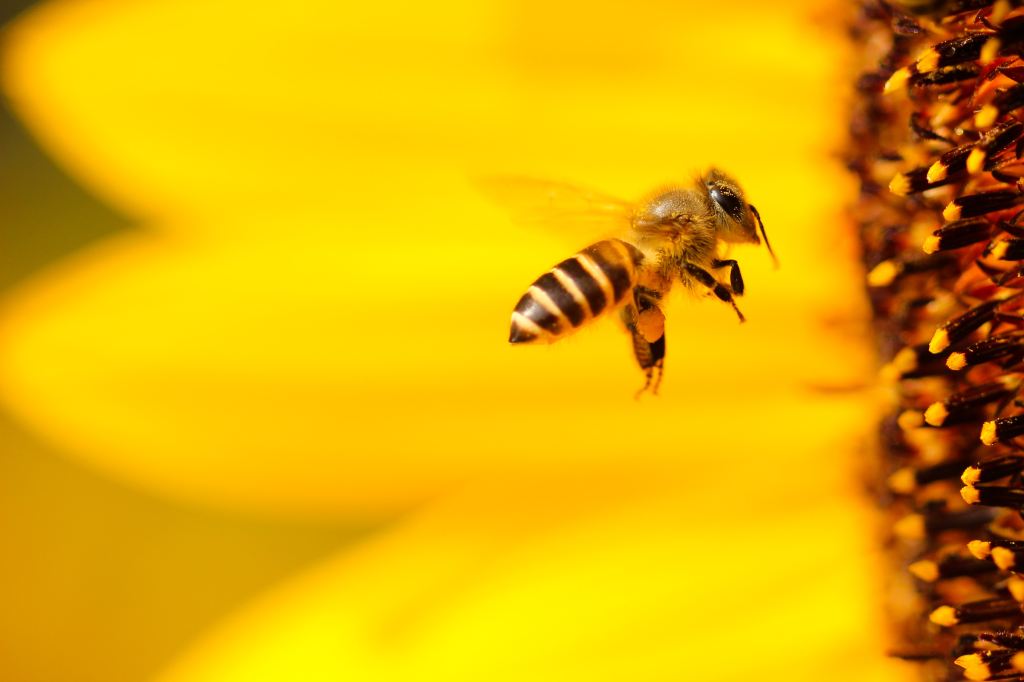
Just in case you’ve forgotten what a bee looks like, here’s a beautiful close up by Boris Smokrovic on Unsplash. Marvel at the pollen baskets on its back legs!

Let’s hear from the Almond Board again.

  • About 1.6 million colonies of honey bees are placed in California almond orchards at the beginning of the bloom period to pollinate the crop.
  • After almonds, honey bees move throughout the United States, pollinating over 90 other crops and making honey.

This is what’s known as migratory beekeeping, and it leads to bees being stressed.

Actually, the term, “migratory beekeeping” makes me cross because it’s wilfully misleading. Bees are most definitely NOT migratory, In normal circumstances, they feed on a wide variety of nectars.

What it means in reality is that hives are trundled from crop to crop as each needs to be pollinated in turn. While the bees are being driven, perhaps hundreds of miles, they’re in closed cartons, unable to fly.

In addition, transporting them from one monoculture to another deprives them of a balanced diet. Almonds are grown in great monocrops – acres and acres of nothing but almonds. Come on, you’d get sick if you ate nothing but chocolate for three weeks and then moved on to baked beans for a month, followed by a fortnight on eggs. This is basically what is required of these “migratory” bees.

Shunting them about the country also increases the risk of spreading parasites and diseases, not only amongst managed hives but also among the depleted wild bee populations they might just encounter round the edges of these monocultures.

In fact, all crops are more effectively pollinated by a mix of honey and wild bees than by honeybees alone. But there are no other foods for the bees, so the farms rely 99% on these “migratory honeybees” with virtually no extra input from other pollinators.

Slave bees, more like.

And then there’s insecticides, upon which almond growers are so dependent. A study last year which looked at the toxic combination of insecticides and fungicides on bees in almond orchards reported the following:

  • increased larval mortality,
  • increased deformed brood
  • a significant number of colonies completely dead.

The decline of bees around the world should make this a matter of deep concern.

A busy bee going about its business on what might be almond blossom – who knows? Marvellous. We must fight their corner. Photo by Zuleika Sequeira on Unsplash

While I’m at it, let’s not demonise farmers. They’re making a living, and many of them are at their wits end as to how to improve farming. The safety of bees, the absurdity of monocultures and the use of groundwater needs to be dealt with by legislation at state and national level.

But St Gwynnie of GOOP drinks it!

Yes, the fragrant Gwyneth Paltrow, the not-as-vegan-as-you-thought goddess with the noxiously idiotic lifestyle website GOOP, apparently has a smoothie made with almond milk every morning – whether or not she is detoxing! So it must be the superest of super things evah, hey?

A random smoothie. Nothing to do with the Blessed Gwynnie. But is that her face appearing in the lime??? Photo by Alina Karpenko on Unsplash

Oh yes, the internet is awash with any number of clean eating influencers promoting the virtue of replacing dairy with almond milk.

So how nutritious is it?

Go to the Alpro website and you will find this list of the benefits of drinking “almond original”. My comments in italics.

  • Naturally Lactose Free
  • 100% plant-based
  • Vegetarian (er… isn’t that the same as 100% plant based?)
  • Naturally low in fat
  • Naturally low in saturated fat (Surely that’s just a subheading under “fat”?)
  • Low in sugars (But since you can get unsweetened almond milk, I think we can assume the these sugars are added…)
  • Rich in Fibre (except all the nut is taken out)
  • A source of calcium. Contains vitamins B2, B12 and D.
  • Source of calcium and vitamins D and B12. (Sorry guys, you just said that!) Vitamin B12 contributes to the reduction of tiredness and fatigue.

Search as I might, I can’t find any evidence to say it’s any better for you than old-fashioned cow’s milk or, for that matter, any other non-animal milk.

Lactose intolerance and veganism

Some people are lactose (dairy) intolerant. Others hate the milk industry and make a moral choice not to drink it. For both groups, doing without milk is a serious nuisance. And this isn’t a perfect world and frequently we have to make quick choices that we know aren’t good for the planet.

But if you do decide to change from almond milk, and I hope you do, oat milk and coconut milk seem to be a wee bit less damaging, even though they come in Tetra Paks which are much less eco-friendly than you might think. (But that’s for another time…)

Better still, make your own almond milk. Buy almonds grown near you (they’re grown in Australia, Europe, Asia and North Africa) and get bottling. Here’s a handy recipe to start you off. Chefs don’t like the pulp, I gather, but there are any amount of recipes out there for using the by-product. Or use it to make an exfoliating scrub.

My final question…

Is it worse for me to buy cow’s milk delivered in a glass bottle which will be used again and again (yes, we still get ours like that!) or a Tetra Pak of almond milk that goes on fouling the planet long after you’ve finished with it?

Ahh, life is so complicated!

***Request for my brother Frank

*** Frank, am I correct in stating that hypoxia and hypoxemia (low oxygen in your tissues/blood) will occur when the mechanism by which methemoglobin is formed is affected, “thereby inhibiting the oxygen-carrying capacity of the blood“? My research seemed to point to this.

Note to the rest of you. My brother Frank is an eminent surgeon, and therefore a proper Man of Science. And yes, I could have asked him before publishing, but I don’t think it hurts to show my areas of ignorance and my efforts to redress this! And besides, I’m off on tour any minute, and want to get this out there!

Meanwhiles, welcome to all of you who have joined recently, and thanks to chuttersnap on Unsplash for the photo of the almonds at the top. Honestly, without the wondrous Unsplash’s free photos, this blog would be very dull to look at.

But of course, the best picture of all is the one of the… yes… wait for it… the One And Only beloved Mutt who has a starring role in this blog.

Quite rightly. She is a very eco-minded Person-Dog as she loves to lick the plates in the dishwasher before the cycle starts, thus extending the life of the machine. She firmly believes that hygiene is less important than waste.

What a clever dog!

BELOVÉD ECO-MUTT!

Her Ladyship in wistful mode, gently fantasising about killing rabbits.
Photo by Jaimondo Sharpe, who is Piper’s second favourite human bean after me.