
TEA BAGS
No, I can’t believe it either. Here we are in the middle of a pandemic and I’m writing about effing teabags, for heaven’s sake!
But I must write about them, because as far as I am aware, almost all teabags are made with one kind or plastic or another, and millions of teabags are chucked in the compost every day.
Just to give you an idea, the annual tea consumption in Ireland averages out at 4.831 POUNDS of tea per person, and here in Britain we’re not far behind, glugging down 4.281 pounds each every year. I personally make up for at least 14 non-caffeine drinkers, as I ADORE tea.
And it’s not just tea – think of all those little sachets of herbal teas! Millions and and squillions and gazillions of bags containing plant matter of one kind or another are disposed of daily. And they look as though they should decompose, don’t they?
Ay, there’s the rub.
How tea bags are made
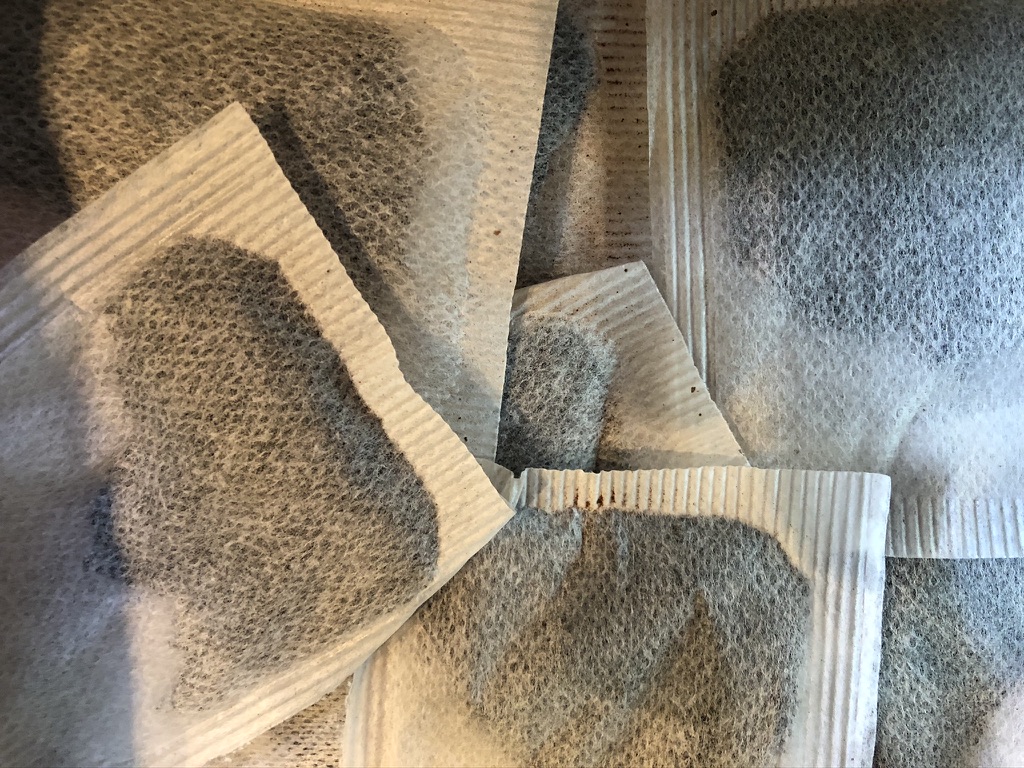
There are various types of tea bags, but the most common is the pressed teabag – in other words, those square or round ones you’re most familiar with.
Here’s a great video from the BBC showing the manufacturing process – if you can’t be arsed to watch it, here’s the low down. Abacá, or Manila hemp, is mixed with water into a sludge. So far, so organic, if you forget about the air miles clocked up getting the hemp to the factory. Oh, and the millions of gallons of water.
This sludge is mixed with flock made from a specialist plastic which is rather like cotton wool. Then a layer of wood pulp is added, having been broken down by yet more uncountable gallons of water. This is to stop the teabag dissolving in your mug.
Finally, it’s dried at 100º and stretched to a fabric just 0.1mm thick. How on earth anyone dreamt it up in the first place is beyond me, but I admit it’s an impressive piece of technology so long as you don’t give a fig about the consequences.
Some of these tea bags use a staple to close the top of the bag but they still have a seam that needs sealing and that’s why they need plastic. The plastic is the seal.
Oh, and don’t forget that white tea bags are only white because the paper is bleached. Nice.
Silky pyramids
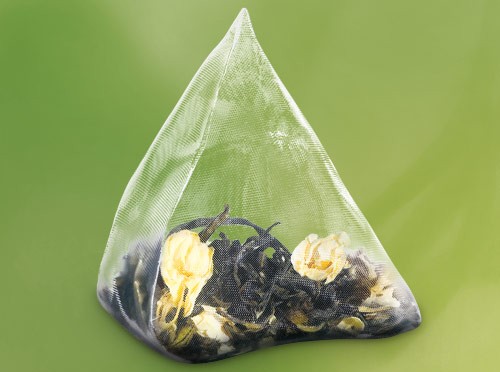
The other type of tea bagis the silky pyramid and a lot of the more poncey teas use these. They’ve become increasingly popular due to the fact that they’re not full of the dusty old shite that inhabits many a teabag. You can actually see the contents and the quality tends to be higher.
The catch is that they’re rarely made of silk. It’s all a question of words… Silky just means “like silk” and this can mean that the teabag is either made of plastic or of what is called biodegradable plastic. And I will tell you more of this when we’ve gone through the process of…
…Heating plastic
Plastic has a very high melting point, so boiling water doesn’t melt it. But there is a second temperature called the “glass transition” temperature – this is far lower than the melting point. This is when molecules in polymers start to degrade. Just because you can’t see it breaking down don’t mean it ain’t happenin’!
Most teabags are made from PET or food grade nylon. PET’s long name is polyethylene terephthalate but don’t try saying that after three glasses of wine. The ‘glass transition’ temperature of PET is a great deal lower than boiling point. But we boil water for tea… so you can be absolutely sure that those polymers in your tea bags are not leaching molecules into your cuppa?
No, I don’t know what the glass transition rate of food grade nylon is, there’s only so much science I can take in without my head swivelling and my eyes starting from their sockets. But I do know that …
- Micro- and nano-plastics are causing increasing concern for their long term effect on the environment and the food chain. It’s worth quoting Aussie businessman and marine ecologist Andrew Forrest again: Nanoplastics… the very, very small particles of plastic, carrying their negative charge, can go straight through the pores of your skin. That’s not the bad news. The bad news is that it goes straight through the blood-brain barrier, that protective coating which is there to protect your brain.”
- According to a study published by the American Chemical Society, “steeping a single plastic teabag at brewing temperature (95 °C) releases approximately 11.6 billion microplastics and 3.1 billion nanoplastics into a single cup of the beverage”.
- We now know that plastic never goes away. Even when it finally seems to disappear, the tiny nano plastics will always be plastic.
Is biodegradable plastic the answer?
Don’t get me wrong. Bioplastics are a huge improvement on petroleum based plastics, but they’re not without problems, and for all sorts of reasons.
- Biodegradable isn’t the same as compostable. Compostable means you and I can chuck it into that pile of grass clippings and it’ll break down. Biodegradable can mean all sorts of things – most bioplastics will ONLY degrade in the high temperatures of industrial composting facilities. There aren’t nearly enough of these, thus bioplastics frequently get sent to landfill. With the best will in the world, can you be certain that your biodegradable teabags will actually BE degraded?
- Some bioplastics (polyethene terephthalate or PET bioplastics) aren’t actually biodegradable. They are recyclable, but they will never become compost.
- Bioplastic MUST be disposed of properly – and this means separately. If it is mixed up with actual plastic it can contaminate a whole batch, rendering that batch unfit for use. This buggers up the whole recycling process. Then where does the batch end up? In our old friend, landfill, making methane. And when you carefully put your bioplastic interdental picks in the recycling, can you be certain the council dump has the kind of sophisticated machinery needed to sort it from the plastic tray that came with your strawberries?
- According to a study at the University of Pittsburgh, biopolymers are worse polluters than ordinary plastic, because of the use of agricultural fertilisers and pesticides. And of course, they take up land which could be used to feed people.
- According to the same study, “biopolymers exceeded most of the petroleum-based polymers for ecotoxicity and carcinogen emissions.”
- A corn starch teabag can still make its way to the sea and into the belly of a fish before it degrades, tricking the poor old fish into feeling full when it’s not. That’s how fish starve to death.
Even the admirable Clipper Teas who have tried so hard to green up, and who are very open about their packaging materials, use a biodegradable plastic called PLA (polylactic acid) to seal their teabags. Now PLA is not toxic – except during manufacture, and very few of us are exposed to that process. However, it has a very low glass transition temperature and I question whether PLA is as stable as we would like: “even things like a hot car in the summer could cause parts to soften and deform“.
Hmm. A fresh brew is considerably hotter than a hot car!
But I cannot stress this enough. I am not a scientist, and I have to work very hard to get through some of these studies. I may get things wrong, and I welcome any contributions and information from people who genuinely understand these things.

We can’t uninvent plastic…
…but we can stop using it when it’s not necessary. Tea bags are not necessary. If you drink actual tea, you can convert back to loose leaf tea just as soon as you’ve finished that last teabag. Same with herbal – there are plenty of loose leaf infusions on the market now.
Look on the bright side – loose leaf tea is almost always a higher quality. The stuff in teabags is usually dust and “fannings“.
You don’t need to worry about a gobful of leaves either. The greatest teapot ever invented is the Chatsford which has a handy basket thingummy to put the tea in. I bought mine 34 years ago in Scotland and the delightful lady said, “You’ll never have bad tea from a brown teapot” and she was right.

I’ve lectured enough. Time for a cuppa. Stay well, stay safe.
Meanwhile, apologies again for the long silence. I find it very difficult to get going in these strange times, and sometimes the science needed to write these pieces makes my head hurt.
Here she is!

 Shit You Don't Need