
CLING FILM / SARAN WRAP
This hideous invention goes by a number of names – plastic wrap, shrink wrap, food wrap, and yes, I do have a roll of it in the kitchen. It’s our very last roll. It’s been there since before Christmas 2016, because I hardly ever use the stuff these days. I clearly remember purchasing it because I also bought a cling film dispenser (also plastic) that meant you could cut a nice clean edge on it.
“How handy!” I thought. I now think, “What a twat I was!”
So if you have a roll of this stuff, please, let it be your last too.
But my food will go off!
Indeed. When exposed to air, moisture, light, and warmth, food will go off. Microorganisms – fungi, bacteria, mould, yeast etc., break food down for their own benefit. The presence of oxygen will simply accelerate the work of these busy little bees, which is why we need to cover food.
So why say no cling film?

The usual problem…
Yes, it’s plastic. Single use plastic. You use it once. Then you chuck it away. (Yes, I’ve tried washing it but that’s not the answer.)
According to a case study done at the Department of Earth Sciences, Montana State University, “the average person produces half a pound of plastic waste every day.” Phew.
A lot of that plastic gets washed into the ocean. Scientists from the Sea Education Society estimate that there are 580,000 pieces of plastic per square kilometre of the Atlantic, which is a depressing thought.
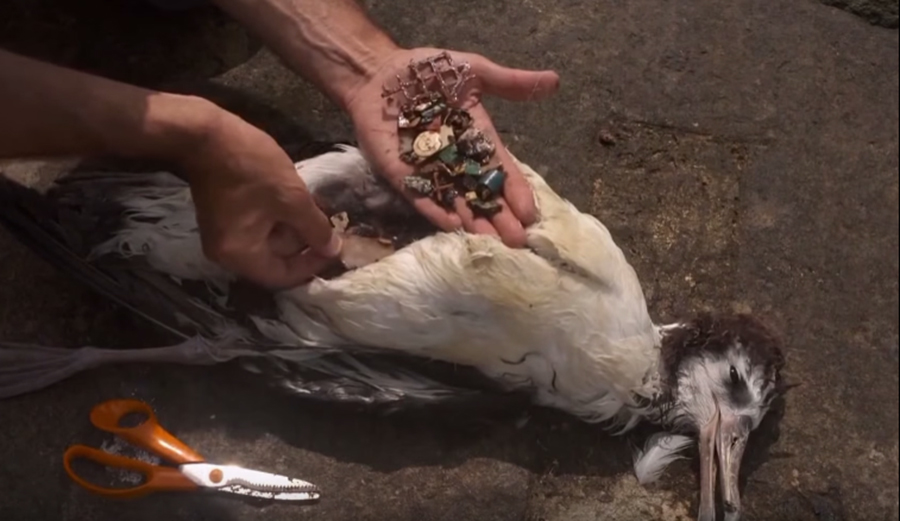
After it has bobbed about in the sea for a while, plastic starts to absorb the smell of food, with the result that seabirds, fish and sea mammals think it’s food.
Take seabirds, for instance. They have evolved over millennia the ability to sniff out krill, the shrimplike crustacean that lives in the oceans in the Southern hemisphere in such millions. Krill emit a strong, sulphurous smell of dimethyl sulfide (DMS). This smell comes from the algae that krill eat, which also smells of DMS.
Well, wouldn’t ya just know that our plastic waste is a perfect place for that algae to thrive. So sea birds, whales and other marine life gobble up these pieces of plastic, mistaking them for krill. Scientists have described this as an “olfactory trap” which is causing marine death on a massive, unimaginable scale.
And then we eat the fish which are full of microplastics.
Danger to humans
Plastic is made to last for ever.
Yes, that’s for ever. As it breaks down into ever smaller and smaller pieces, it becomes invisible to the naked eye. But it is still there. We are eating it and taking it in in our drinking water. Americans, for instance, gobble down between 39000 to 52000 microscopic particles of plastic per year. Yikes.
And it’s not just in the sea. In the Pyrenees, a scientific study discovered that there were 365 microplastic particles per square metre falling out of the sky every day. And yet the Pyrenees is supposed to be a relatively pristine area, lightly populated, with no industry to speak of. It’s at least 100k from any obvious source of microplastics. So we’re breathing them in as well as eating them. Yikes, yikes, and thrice yikes…

Photo of the Pyrenees by Michael Liao on Unsplash
It gets worse
There’s something even more scary than microplastics, and that’s nanoplastics. As plastic goes on degrading and shredding, the particles get tinier and tinier. It’s reckoned that a billion nanoplastics can fit on the head of a pin. Science is only just catching up with these babies.
Studies have shown that when aquatic organisms ingest nanoplastics made of polystyrene, these can be passed through cell walls. What will happen when those nanoplastics accumulate in our lungs, in our blood vessels, in our brains?
In a recent TED talk by Australian mega-businessman, philanthropist and marine ecologist, Andrew Forrest PhD, he described plastic as “an incredible substance designed for the economy… the worst substance possible for the environment… it never stops being plastic.”
He goes further, and it’s worth quoting him at some length because he’s done the science and can explain it better than I can. (And his sister’s a very old pal of mine and I know he won’t mind.)
“The breaking science on this… which we’ve known in marine ecology for a few years now… Nanoplastics… the very, very small particles of plastic, carrying their negative charge, can go straight through the pores of your skin. That’s not the bad news. The bad news is that it goes straight through the blood-brain barrier, that protective coating which is there to protect your brain.”
“Your brain’s a little, amorphous, wet mass full of little electrical charges. You put a negative particle into that, particularly a negative particle which can carry pathogens – so you have a negative charge, it attracts positive-charge elements, like pathogens, toxins, mercury, lead. That’s the breaking science
we’re going to see in the next 12 months.”
So do you still fancy using one-off plastics?
Recycling?
Sorry, but that just doesn’t happen with shrink wrap. Firstly, it clogs the machines. Secondly, you can’t recycle it with plastic bags at the supermarket because removing the phthalates, the various complex chemicals that render the cling film stretchy, is impossible.
Anyhow, recycling plastic merely delays the eventual moment when the stuff hits landfill, because plastic can only be recycled so many times. Aluminium, on the other hand, can be recycled an infinite number of times.
Hurrah for tinfoil!
More…
There is SO much more I could say about plastic, but I’ve depressed myself enough for one day. I’ll save it for another piece. Let me leave you with a question, however. If turmeric and paprika can leave ineradicable stains, and other foods leave their smells in plastic containers, it suggests that plastics aren’t as impermeable as you might assume.
So if plastic can absorb colour and smell, can the chemical transfer can also go the other way? How certain can we be that the chemicals used to make the plastics aren’t leaching into our food? After all, manufacturers of plastics are not required to declare what additives are contained in any plastic, and there are literally thousands of those possible additives.
Wouldn’t it be better to wrap leftovers in greaseproof paper or foil? Or in a bowl covered with a plate? Or even in a lidded plastic box you can use time and again?
Meanwhile, the celebrated primatologist and general good-eco-egg, Jane Goodall, said, “Every single person makes some impact on the planet every day.”
Could you let today’s impact be a resolve never to buy cling film again?
Endpiece
Once more, apologies for the intermittent nature of this blog. I’d set myself the task of publishing one every two weeks, but lately I have been chained to the piano, trying to write new material for my next theatre show. And to be honest, it’s tough work, reading and distilling all the research needed to back up my case. Much of the time, I feel I’m whistling in the wind and it’s just pointless, but then I think, perhaps if enough of us whistle in the wind, we might just be heard and start to make a difference.
So please do share this with friends and family. If you enter your email address and click on the blue follow button, you’ll get an email every time I publish a new piece, which is not more than once every two weeks. I promise you won’t get smothered in unwanted emails!
Unnecessary dog picture
Meanwhile, since we all need cheering after that diatribe about plastics, here is the mutt looking particularly feral after rolling in the hay.


































 Shit You Don't Need